



Louise used to coach entrepreneurs and couples with ADHD issues, and this was always one of her strongest pieces of advice: “Do what you’re good at, and hire out or delegate the rest.”
She learned that from being married to me all these years and raising three Hunter kids. When we started the radio show 23 years ago, for example, I had piles of papers all over the studio (that was in our living room in Montpelier, Vermont at the time).
Each pile was meaningful to me, as I have — as she’s pointed out over the years — a piling rather than a filing system because, like a typical Hunter, if I can’t see something it ceases to exist.
So Louise picked picked up an old postal sorting piece of furniture from a second-hand store. It was about four feet high by six feet wide and had about fifty little boxes facing out where they used to stick mail. She put labels on half the boxes and sorted my piles into them, and instantly I could grab an article or bit of research on the fly when I needed it to rant about it on the air.
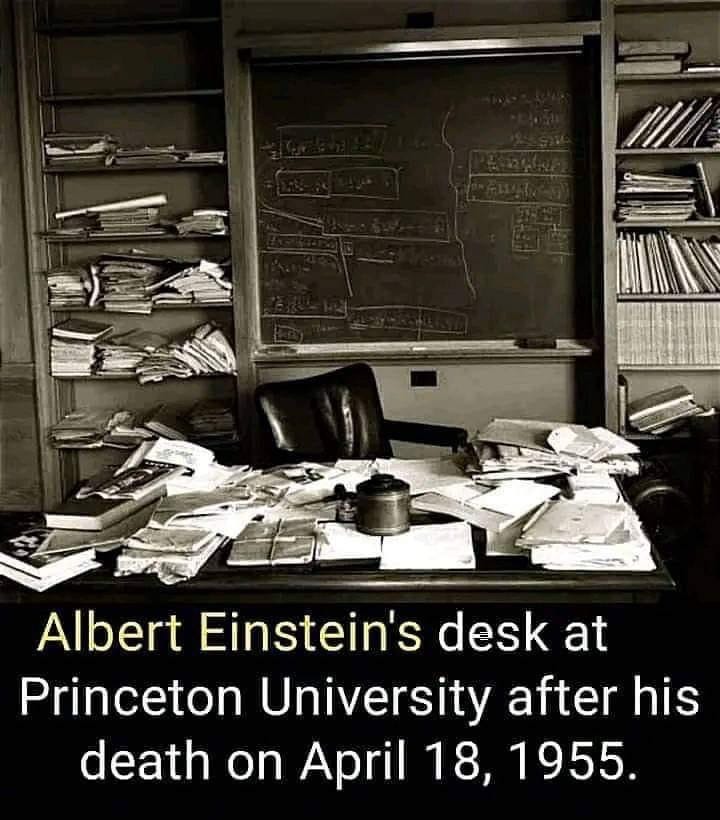
I’m terrible at being organized, at least in the conventional sense (my favorite picture, which hangs on the wall of our studio, is a photo of Einstein’s desk when he died) and Louise is really good at it, so she just took over that part of our work together. I’m pretty good at being a talk-show host, though, so I did that.
Similarly, a friend of ours started a small business just down the road from us and one day over dinner was complaining about how much he hated doing all the bookkeeping and taxes that are a necessary part of running your own business. She strongly recommended that he hire a bookkeeper or a payroll service and he did both.
Six months later he was expanding his business, because now that the stuff he hated was under control he could refocus his energy on things he was good at like visiting potential customers to sell his services. It’s now so successful and running on its own as he’s learned to delegate responsibility that he’s regularly taking trips around the world to pursue his diving hobby.
And now science is catching up with her advice. The largest study ever published on the strengths people with ADHD have dropped last October, titled “The role of psychological strengths in positive life outcomes in adults with ADHD.”
They found that most people with ADHD identify the same strengths they have, including creativity, hyperfocus, intuition, broad interests, “being up for anything,” spontaneity, and humor, and that those people who worked with their strengths and outsourced their weaknesses did far better in life than Hunters who instead tried to do everything. Their exact conclusion was:
“We conclude that … interventions that focus on enhancing people’s strength knowledge and promoting the everyday use of their personal strengths could have universal applications to improve wellbeing in adulthood.”
They also found that those Hunters who played to their own strengths also excelled in the key requirement for success in life: Perseverance.
When Louise and I were first married, I was very into the self-help movement at the time, and had a poster on the wall of our bedroom that we carried with us from apartment to home to home for decades. It purported to be a quote from President Calvin Cooledge, although its origin is broadly disputed. Nonetheless, it changed the course of our lives.
“Nothing in this world can take the place of persistence.
“Talent will not: nothing is more common than unsuccessful men with talent.
“Genius will not; unrewarded genius is almost a proverb.
“Education will not: the world is full of educated derelicts.
“Persistence and determination alone are omnipotent.”
The other amazing detail the researchers found was that the self-reported “severity” of ADHD symptoms bore no relationship to eventual adult success in relationships and the world. Instead, the single variable was a person’s persistent embrace of their strengths.
That study also lines up with one published just five months ago in the Journal of Attention Disorders that looked at 125 separate studies on adult ADHD strengths, an examination that literally did not exist in the 1990s when I started singing this Hunter-in-a-Farmer’s-World song. Here’s what they concluded:
“It was observed that typical ADHD characteristics were sometimes perceived or redefined as strengths: interest-based attention or positive differences in attentional ability (n = 52; 42%), energy or positive differences in activity levels (n = 33; 26%), and adaptive risk-taking or positive aspects of impulsivity (n = 19; 15%). Other strengths identified across studies included: creativity (n = 82; 66%), prosocial attributes (n = 39; 31%), entrepreneurship (n = 14; 11%), resilience (n = 16; 13%), flexibility (n = 14; 11%), uniqueness (n = 16; 13%), and other characteristics (n = 24; 19%).”
This isn’t just good advice for Hunters, by the way. Harvard’s Ashley Whillans and colleagues surveyed over 6,000 adults across four countries and found that those people who shifted the workload from themselves to others so they could do what they loved or were good at had substantially higher life satisfaction. Purchases that “bought time” away from drudgery (like hiring a maid or bookkeeper, etc.) and thus freed up time for interesting things were more highly valued than purchases of goods.
Those who didn’t hire help for the stuff they hated reported that they forced themselves to do those jobs — even while sacrificing quality of life — generally did so because they believed doing so proved they were “lazy.” They either judged themselves or feared being judged by their peers or family.
“Lazy,” of course, is the label that’s been hung around the neck of every Hunter kid who ever encountered a public school. I was labeled lazy in second grade (in part because I could already read the lessons bored me silly), before I finally got enrolled in Dwight Eisenhower’s gifted kids program (in reaction to Sputnik going up in 1957).
When we grow up with that word echoing in the back of our memory all the time, hiring or asking a spouse for help, or telling an employer what you can do well and what they should farm out to others (pun intended) seems to prove it. It feels more like a confession than a strategy.
But another systematic review of 79 studies covering more than 68,000 workers with ADHD diagnoses found that ADHD can be a real asset in the workplace when the workplace accommodates itself to a Hunter’s brain wiring. Their conclusion:
“ADHD confers multiple challenges and strengths related to employment but this relationship is largely dependent upon person-environment fit and appropriate workplace accommodations. Neurodiversity is not necessarily a hindrance if individuals with ADHD are permitted to adapt their working conditions and work in a supportive environment. We recommend that employers, supervisors, and coworkers embrace the strengths conferred by ADHD and adopt inclusive hiring and managing practices.”
Not everybody, of course, can hire a bookkeeper or housekeeper, but delegation and hiring help aren’t the only options available to us Hunters. In the case of Louise and me as partners in the roughly 7 business we’ve started and run over the past 50+ years, we simply divided up the work according to what each can do best. We do that with household responsibilities, too.
This is sometimes called “Job Crafting,” quietly reshaping your job so more of the week is spent on those things you do well rather than the things you hate and thus do poorly. Advances in AI are also helping a lot of Hunters adapt; Sari Solden wrote brilliantly about this just a few weeks ago.
So consider taking a little time to evaluate the parts of your work or life that are fulfilling, where persistence is driven by enthusiasm, and compare them to those that are drugdge work, and see how you can change things around. I can testify from my own experience that it can make a big and genuine difference.