


Back in the early days of my business career, I discovered that I do my best work in bursts, at odd hours, in (often messy) places I’ve arranged to suit my own brain.
I wrote big chunks of my first book on ADHD at two in the morning, surrounded by what my wife Louise lovingly calls my “piling system.” I loved the quiet and lack of distractions, and by putting things in piles instead of folders I always knew where things were.
I frankly can’t even imagine spending my working life in a fluorescent room with a supervisor walking the aisles and a phone ringing four desks over.
I’ve been thinking about this a lot lately because 2026 has become, according to the media, the year of the great march back to the office. After five years of letting people work from home, companies are now starting to issue five-day-a-week here-instead-of-home mandates.
One workplace consultancy noted this spring that these kinds of office mandates have triggered a surge in accommodation requests that most employers weren’t ready for, and a big share of those requests are coming from neurodivergent workers who’d spent the pandemic figuring out how to thrive at home…and are now being told to show up in the office.
This entire drama is the Hunter and Farmer conflict playing out in real time, although almost nobody is calling it that.
But the open-plan office wasn’t designed for Hunters. It was designed for Farmers, and it was designed by Farmers, the very same way nearly everything in our institutional world has been since agriculture took over about ten thousand years ago and then was replaced by machines and now computers.
A Farmer’s brain is built for sustained, repetitive, low-novelty attention in a fixed location: sit in one spot, do the predictable tasks, ignore any distractions, and then repeat tomorrow for years. That’s not an insult, by the way; it’s an extraordinary and necessary skill that fills the granaries and keeps the lights on.
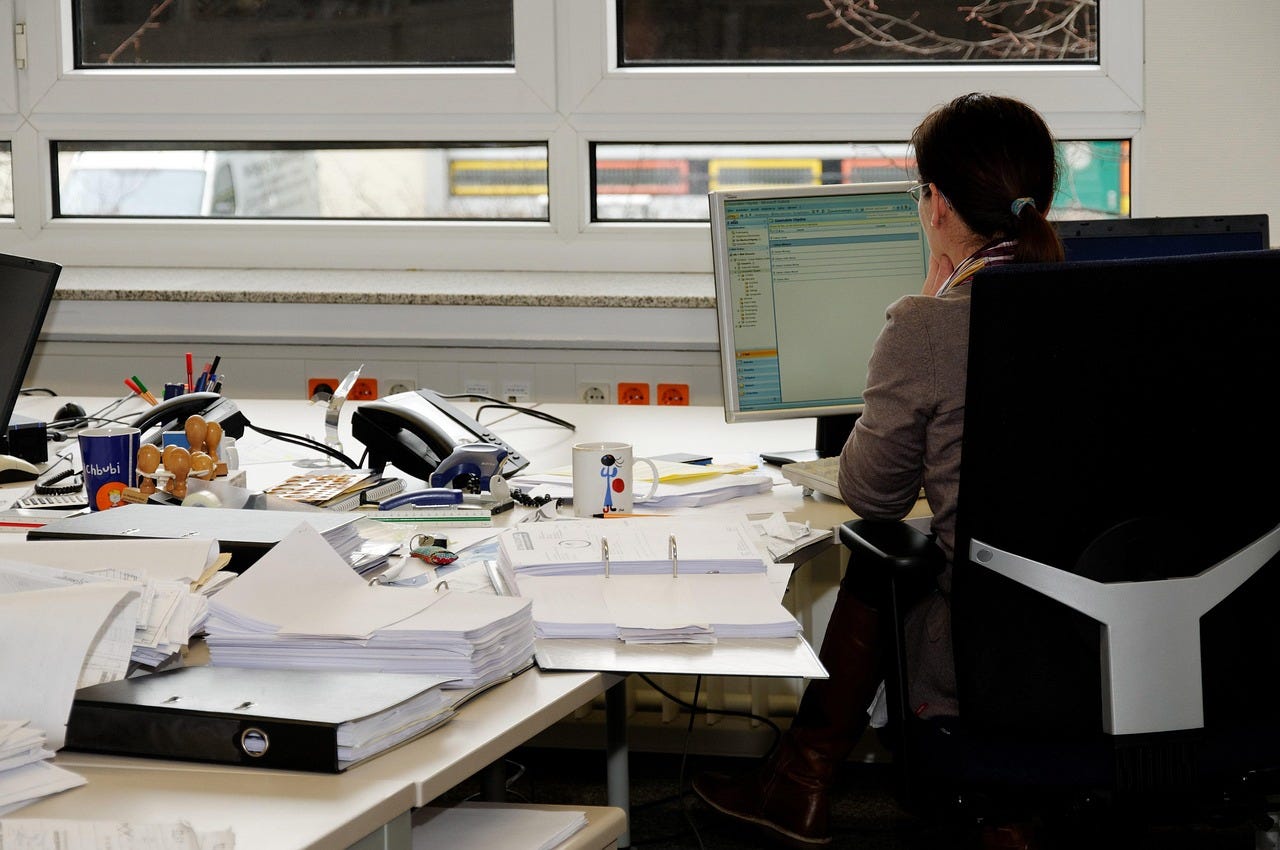
The office, with its rows of desks and its nine-to-five rhythm and its culture of being seen at your station, could be thought of as, essentially, a climate-controlled wheat field. It rewards the people who can pick bugs off plants, hour after hour, day after day, year after year, and find it rewarding.
But look what happens when you drop a Hunter into that field. The Hunter’s brain is a scanning instrument, built to track everything in the environment, to notice the rustle in the grass and the shadow at the edge of the clearing: for most of humanity’s hunter/gatherer history the person who noticed everything was the person who ate dinner and didn’t become some big animal’s dinner.
The brain of a Farmer is wired for a kind of sustained, unvarying attention at a fixed post: put in one spot, go through the predictable motions, put aside any distractions and do it all over again come tomorrow. No insult intended here; it’s an essential talent to keep the lights on and the granaries full.
In its way, the office with its nine-to-five cadence and rows of desks is like a climate-controlled wheat field. There’s a certain reward in being seen at your station or picking bugs off plants for hours on end.
In an open office there’s nothing of value for that radar to fix on, so it fixes on all it: the typing of a colleague, the coffee machine chatter, the door swinging open. By three o’clock the Hunter is exhausted from the effort of filtering, with less to show for it than he’d have after two hours of concentration at his kitchen table.
I’m not alone in this assessment; the workers themselves tell us as much. The Washington Post recently examined the response to these mandates and came across neurodivergent staff who said the home office was the first place they could put their own spin on their environment and energy.
They’d made their own hunting ground. One woman told the Post that she was merely trying to get by in a society not constructed for her. I have heard that, in one form or another, from virtually every Hunter I’ve spoken with in my nearly forty years of listening to them.
There’s a bitter irony here. Many of them were doing fine work from home. The company’s issue was never with the output but with the optics, with control and the old Farmer notion that if a supervisor isn’t looking over your shoulder it isn’t real work. And now we’re rescinding the very tools that allowed Hunters to work in their element because it puts the Farmers running things at ease.
Researchers, however, are cautioning against it; a British study has shown that such rigid return-to-office policies can be a hindrance to disabled or neurodivergent employees and serves only to entrench inequality in the workplace.
Researchers studying these policies are now warning businesses that these strict in-office rules tend to deepen workplace inequality rather than improve performance, and that they hit those people hardest whose brains don’t match the standard mold. One British analysis explicitly discovered that return-to-office mandates can actively disadvantage disabled and neurodivergent staff who’d used working from their homes to manage their distraction and exhaustion.
We finally handed Hunters a tool that let them work like Hunters, the ability to work from home in their own space, and now we’re taking it away because it makes the Farmers in charge uncomfortable.
There are some real positives to having everybody in the office. They include mentoring, the accidental hallway conversation, and the energy of a team solving problems or building things together. For many people, including many Hunters, some of that in-person time produces genuine benefits.
So, the error wasn’t bringing people together but, rather, the one-size-fits-all decree, based on the false assumption that there’s a single correct way for a human brain to be productive and that that way is the Farmer’s way, performed in the Farmer’s environment, on the Farmer’s schedule.
We’ve built an entire economy that increasingly runs on the very traits Hunters are good at. Novelty. Pattern-spotting. Rapid pivots. Comfort with risk and chaos.
About a fifth of adults today describe their own brains as wired differently, according to surveys. And that number is steadily climbing as more people read about things like ADHD and find the language to describe what they’ve always known about themselves but couldn’t put into words.
Corporate leaders, however, often force highly creative problem solvers back into traditional office rows, where their strengths are mistaken for symptoms.Instead, people with ADHD should be able to design their workspace.
Where possible, give them quiet, give them flexibility about hours, judge them on what they catch rather than on how many hours they sat still.
Years ago I told my son, who’d just been handed an ADHD label that nearly crushed him, that he had two choices in a world run by Farmers. He could learn to fake the Farmer behaviors when he absolutely had to, or he could find the corners of the world that actually wanted what his brain did naturally.
What I didn’t know then was that one day technology would carve out a third option, a way to do real work for real companies from a place a Hunter got to design. After the pandemic shock, we just spent five years proving it worked. Now would be a foolish moment to forget.
So if you’re a Hunter staring down a return-to-office mandate this year, know two things.
First, you’re not broken and your exhaustion doesn’t mean failure. Your brain is staying alert because the office offers little meaningful information to process. It’s doing exactly what it evolved to do.
Second, you have more both legal and moral standing to ask for what you need than you might think, and there’s a growing pile of evidence on your side.
If this gave you words for something you’ve been feeling, forward it to the Hunter in your life who’s dreading Monday, and subscribe here so we can keep making the case together. The Farmer’s field isn’t the only place worth working. It never was.
