

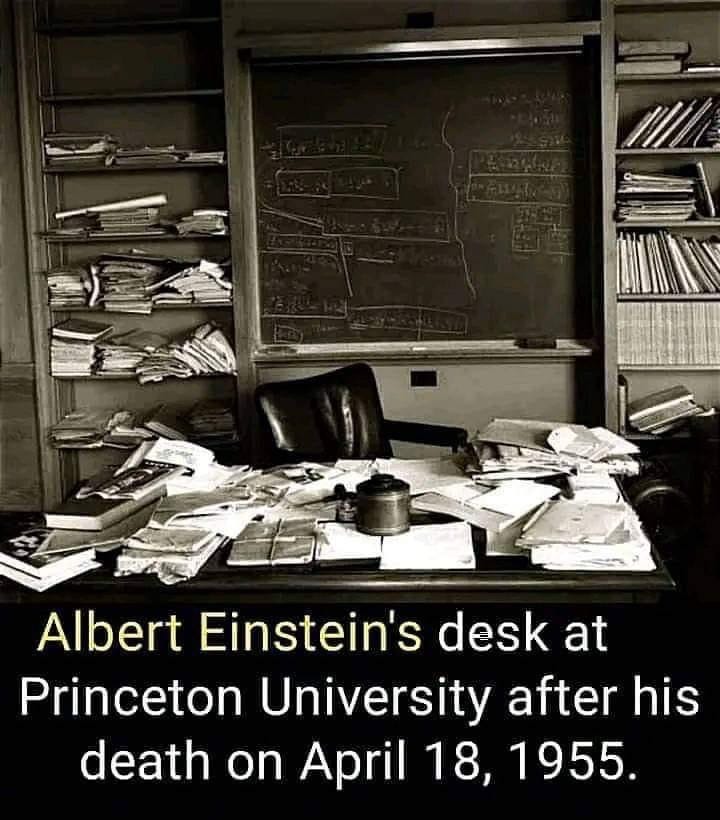
Louise has a line about me she’s been using for over forty years. She says I don’t have a filing system, I have a piling system.
It’s true, and it’s not going to change. My office has always looked like a paper avalanche froze in mid-collapse, because the part of my brain that should sort and label and put things in their proper folders is the part I got shortchanged on. My one consolation is the picture above, which hangs on my wall.
I can chase an idea across three decades and a dozen books. But ask me to maintain an orderly calendar or remember to file the thing or break a big project into tidy sequential steps, and you’ve found the exact place where my Hunter brain runs out of road. For most of my life, the only fix was to marry a Farmer (did that), hire a Farmer (did that, too), or simply suffer (did a lot of that!).
So you can imagine how I feel watching what’s happening right now, as ADHD adults all over the world discover that they can, for the first time in history, put a Farmer on staff for almost nothing.
I’m talking about the way people with ADHD have started using AI. Not for the diagnosis stuff I wrote about a few weeks back, but as a daily working tool, a kind of tireless assistant that handles the very jobs a Hunter’s brain handles worst.
The neurodivergent corners of the internet have been buzzing about this for a while now, and the more thoughtful write-ups have started calling it what it really is.
One foundation that works with ADHD students and adults described AI not as a productivity gimmick but as external executive-function support, a system that helps stabilize thinking, cut down overwhelm, and actually get a person moving.
That phrase, executive function, is the clinical name for exactly the cluster of skills Hunters tend to struggle with. Planning. Prioritizing. Sequencing. Remembering. Starting the boring task and then, God help us, finishing it.
Think about what that means through the lens we use here. The Hunter is brilliant at the things a hunt requires: scanning, improvising, spotting the pattern nobody else saw, locking into ferocious hyperfocus when the chase is on. What the Hunter is bad at is the Farmer’s work, the patient, orderly, one-step-after-another labor of maintaining a system over time.
And the cruelty of the modern world is that it buries the hunt under mountains of Farmer’s work. To do the exciting thing you love, you first have to schedule it, budget for it, email six people about it, and break it into a project plan.
For a Hunter, that pile of administrative underbrush is often the thing that kills the dream before it starts. Not because the Hunter lacks the talent. Because the Hunter lacks the patience for the paperwork standing between him and the talent.
What AI does, when a Hunter uses it well, is clear the underbrush. The members of one ADHD peer-support community reported using these tools to break overwhelming tasks into manageable steps, the single move that paralyzes more Hunters than almost anything else.
Adults have described handing the machine a tangle of obligations and getting back a clean schedule, or dumping a chaotic pile of thoughts and getting back a draft they could actually edit.
Writers with ADHD talk about using it to get over the first hurdle, to brainstorm, research, or produce a rough first version so they’re correcting instead of facing the terror of a blank page. The tools that seem to help most, according to people who’ve tested a stack of them this year, are the ones that hold onto context across days so the Hunter doesn’t have to keep everything balanced in a working memory that was never built to hold it.
I’ll be honest, the first time I really understood this I felt something close to grief, the good kind. I thought about my son at twelve, drowning in a school system that judged him on his weakest skills. I thought about the boy at the treatment center who couldn’t sit still. I thought about my own piling system and the assistants and family members who’ve spent years being my external memory out of love.
And it struck me that a kid getting an ADHD diagnosis today is walking into a world where, for the price of next to nothing, he can hand the Farmer’s work to a machine that never sighs, never judges, never makes him feel like a failure for needing to ask the same question twice.
That’s not a small thing. For a lot of Hunters, that’s the difference between a dream that dies in the underbrush and a dream that gets to be hunted.
But you know I won’t sell you hope without honesty, so let me plant a flag here: there’s a difference between hiring a Farmer and becoming dependent on one.
The machine is a magnificent tool for the Farmer’s work, the sorting and sequencing and drafting. But it isn’t a substitute for the Hunter’s judgment, and that’s the part I’d never want anyone to outsource.
The whole gift of the Hunter brain is the leap nobody else would make, the connection nobody else saw, the willingness to chase the strange idea across the clearing.
A machine that’s trained on everything everybody else has already done is, almost by definition, a Farmer. It’s good at the well-trodden path; it’s not the one who finds new country.
So use it to clear your road, by all means, but don’t let it decide where the road goes. Researchers poking at how well these tools actually design support plans have found the output can be coherent and useful but uneven, strong in places and shaky in others, which is exactly what you’d expect from an assistant who’s diligent but doesn’t really understand the hunt.
Check its work. Keep your hand on the wheel. It’s the plow, not the farmer who knows the land, and it is most certainly not you.
There’s an irony in all this that I can’t help savoring. For ten thousand years the Farmers ran the show, and the Hunters had to bend themselves into Farmer shapes just to get by, faking the orderly behaviors, taking the Farmer pills, apologizing for the piles.
Now, suddenly, the Hunters get to keep being Hunters and rent the Farmer skills by the hour. The thing the culture spent centuries shaming us for not having, we can now simply pick up off the shelf, and get back to the work our brains were actually built for. I don’t think we’ve begun to reckon with how much that’s going to unleash.
If you’re a Hunter who’s never tried this, I’d encourage you to start small and start today. Take the one task that’s been sitting on your list for three weeks, the one that’s not hard so much as it’s tedious and shapeless, and ask the machine to break it into the first three steps. Watch what happens when the underbrush clears and the hunt is suddenly right in front of you.
And then come tell me about it, because I want to know. Subscribe here and forward this to the Hunter in your life who’s still trying to do all the Farmer’s work alone. They don’t have to anymore. For the first time in human history, they really don’t.
Thank you for such a constructive article. Not only is it helpful for self understanding, but also for understanding other people and working harmoniously with them.
Yes! Yes! Yes! I love it for a very specific reason. I am a good home baker and want to turn semi-pro. I went to the community college to learn but each day had at least a dozen focuses calling me. Half way through the quarter I still hadn’t done my first homework assignment because I had no idea how to prioritize them and where each fit into the scope of professional baking. But I did learn a few essential skills and met wonderful and generous teachers. So I quit and semi- shelved my ambitions but kept baking because it made my friends (and me) so happy. Then I ventured into AI and at every step I learned way more than what I had asked for. And every time I bake now I get smarter as I apply something lightly related to earlier projects and I tweak it and invent something new. I am quickly moving up from home baker to pro and growing my own thinking and recognizing my natural skills that had lain dorment. It’s a RIDE.