


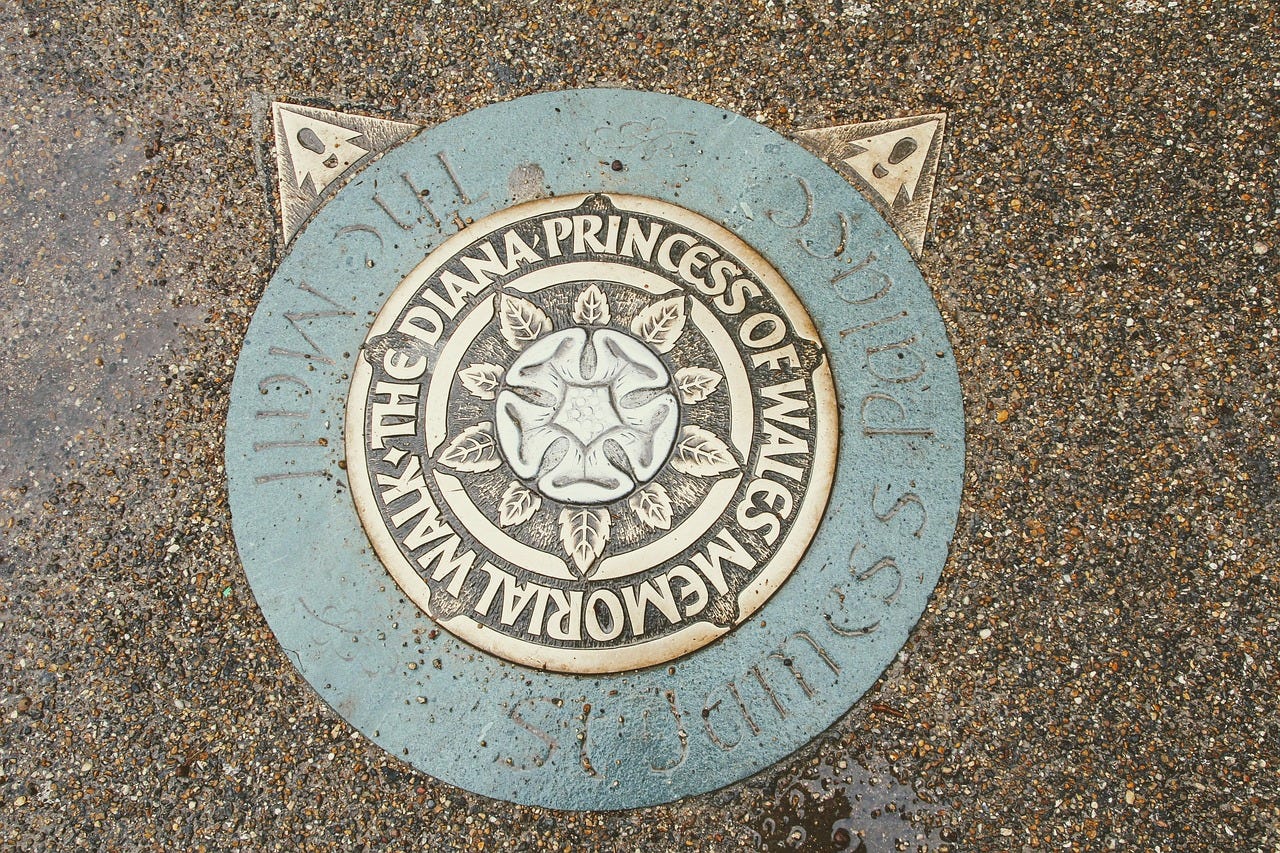
Last month, Princess Diana’s younger brother, Charles Spencer, published a memoir called Swan Song: Diana, My Sister. It’s accusations against King Charles have gotten all the publicity, but I was fascinated by the parts where he talks about both him and Diana having ADHD.
He tells the story of how, later in life, he was diagnosed with “severe ADHD” and that when he thinks back on his late sister it’s obvious to him that she shared the same type of neurochemistry, even though she was never tested.
He notes that through most of her life people around Diana explained her intensity and her wounded withdrawals from friends and family using words like “paranoid” or “borderline.” In fact, he says, she was suffering from the pain of being misunderstood by Farmers in a Farmer’s culture; using his words instead of mine, he wrote that “rejection for people with ADHD goes very, very deep.”
When I read that, I immediately remembered being in England the first week of September 1997.
Sari Solden and I were both there to speak at one of the first conferences on ADHD ever held in Britain. Sari had recently published Women with Attention Deficit Disorder, the book that pretty much launched the entire field of women and ADHD, and I was there to talk about my theory of Hunters and Farmers.
Diana had died in Paris just days earlier. We’d come to teach people about a condition most Brits had never heard of, and we found ourselves in the middle of a nation in shocked mourning. The funeral was that same week, and we saw it all, the flowers and the crowds and the stunned quiet of a country that couldn’t quite believe that their beautiful, compassionate princess was gone.
Sari wrote about that week on her Substack a few days ago. She remembers standing up in front of a room full of British women, many of whom had spent their entire lives feeling like they didn’t fit and never knowing why, and — decades before Charles Spencer shared his thoughts about the way his sister’s brain worked — telling them that she believed Diana had many of the characteristics of a woman with undiagnosed ADHD.
Sari was both prescient and a trained and smart observer: she was almost thirty years ahead of Diana’s own brother. She also pointed out something I’d never put together in all the years since: “Diana” is the name of the Roman Goddess of the Hunt.
Her brother knew that well; in his eulogy that week at Westminster Abbey he noted that the woman named after the Goddess of the Hunt had ironically become “the most hunted person” of the modern age.
But Diana wasn’t only hunted by the press and photographers; she was also a Hunter, and she’d married into the most thoroughly Farmer institution on Earth.
That’s what a monarchy actually is. It’s a thousand years (literally!) of doing the same things in the same way, over and over again. Stand where you’re supposed to stand, wear what protocol requires, say words written for you by professional speechwriters, smile in way you’ve rehearsed, and be perfectly respectable.
And then do it again tomorrow and next week and next month and next year for the rest of your life. I can only imagine the pain Diana must have experienced; I sure couldn’t have done it.
In the British royal family, novelty is a threat and spontaneity is a “breach of protocol.” For that family’s long lineage of Farmers (with a few notable exceptions through the centuries) it’s just The Way Things Should Be. For a Hunter like Diana, though, it’s like living in a cage.
But, amazingly, look at what she did inside that cage.
Diana largely dumped the script: in 1987, when the world was still terrified of AIDS patients and the disease was considered incurable, when Ronald Reagan was still refusing to fund AIDS research or even mention the word, she visited AIDS patients in the hospital, took the hand of a man dying of the disease — without gloves — in front of the cameras.
A decade later she walked through an active minefield in Angola to highlight the danger of land mines she crusaded against. Her brother told Marie Claire that she had an ability to cut through the “conventional way of looking at a cause” and see the part that really mattered, and of her ADHD he said, “I think it enhanced the natural empathy in her.”
That’s the Hunter’s gift, and, for Diana, it came with the Hunter’s price. Put a person wired like that into a family that prizes emotional restraint above nearly everything, and you’ve set up a disaster. I’m guessing the same could be said of Prince Andrew’s former wife, Sarah Ferguson.
Also interesting is what Charles Spenser says the diagnosis did for him. He told Marie Claire that finding out late in life helped him understand things better, and that being able to pause in the middle of an overwhelming feeling and think, “this is how I’m wired, maybe that’s why I’m feeling this,” made all the difference.
That’s why I first started writing about Hunters and Farmers back in the 1990s. I wanted to give these kids (and adults) permission to be themselves, to see without artifice or BS what their weakness were but also what their strengths are and how they can be used.
I wish somebody had given one of my or Sari’s books to Diana; it may have changed or even saved her life.
Sari ended her post by asking her readers how they’re going to protect their own light this month. It’s a good question for every Hunter reading this, and it’s one she and I are going to dig into together.
This Saturday, October 17th, at noon Eastern, Sari and I are sitting down on Zoom for the first time in years to talk about those early days, about women and ADHD, about where we agree and where we don’t, and about what we’ve each learned in the three decades since that week in England.
It’s free for subscribers to either of our Substacks, and we’ll release the recording right afterward. If you’ve got a question for us, email it to sari@sarisolden.com with “questions for Thom and Sari” in the subject line. And if you haven’t yet, subscribe to Sari’s newsletter and to this one, and pass this along to a Hunter you love who still thinks she’s broken.
The Hunter/Farmer explanation of ADHD “symptoms” is very interesting and hopeful for many people. It goes towards also explaining things like the animosity between white collar and blue collar, academics and labor and other class problems.
Is there anyone teasing out the Hunter/Farmer aspects from other psychological influences for people currently diagnosed with ADHD? It seems that there are a lot of things lumped into the ADHD diagnosis that might be Hunter versions of things like stress, trauma, etc., which would be better assessed directly than by hit and miss attempts with drugs and social isolation.
Also, what are your thoughts on people who are somewhat both Hunter and Farmer, like me and maybe even yourself? I feel that’s my case and it seems plausible, especially considering that two people who have a baby may themselves represent both Hunter and Farmer.